Hello guys, I’ve joined and gone through 30+ SQL and database courses across every major platform in last 20 years. Not just watching — actually completing them, doing the exercises, building projects, and testing my knowledge against real-world scenarios. Most SQL courses are either too shallow (surface-level coverage that leaves you unprepared for real work) or too academic (heavy on theory, light on practical application).
But after sorting through the noise, I’ve found 7 exceptional courses that will genuinely transform how you work with data.
These aren’t just “learn SQL basics” courses — they’re the resources that separate developers who can query a database from those who architect data solutions, optimize performance, and solve complex business problems with SQL.
Here are my top 7 SQL courses for 2026.

Why These SQL Courses Stand Out?
Before we dive in, understand what separates exceptional SQL courses from mediocre ones:
Real-World Focus — Teaching SQL as it’s used in actual jobs, not theoretical exercises
Progressive Difficulty — Starting with fundamentals and building to advanced topics at a sensible pace
Hands-On Practice — Extensive exercises where you write actual SQL queries and see immediate results
Multiple Database Systems — Teaching across PostgreSQL, MySQL, SQL Server, and Oracle (not just one)
Interview Preparation — Covering the SQL questions companies actually ask
Performance Optimization — Teaching not just how to query, but how to query efficiently
Instructor Credibility — Taught by people with real production experience, not just technical writers
Active Community — Access to peers, instructors, and resources for learning support
The courses below all meet these criteria. They’re worth your time and money in 2026.
Top 7 SQL Courses and Platforms for 2026
Without any further ado, here are the top SQL courses you can join online to learn and master SQL in 2026. These courses will not just tell you SQL basics and syntax but also key concepts like how SQL join works? How grouping works? How Window function works etc, and most importantly how SQL query works.
You will also learn major databases like Oracle, SQL Server, MySQL and PostgreSQL along the way.
So, what are we waiting for, let’s start
1. The Complete SQL Bootcamp — Udemy
Platform: Udemy | Duration: 13.5 hours | Students: 1.2M+ | Rating: 4.8/5
This is the gold standard for SQL beginners on Udemy. The course is bootcamp-style — intense, comprehensive, and designed to take you from zero to productive in SQL quickly.
What You’ll Learn:
- SQL fundamentals from absolute scratch
- Database creation and management
- SELECT statements and data filtering
- Joins (INNER, LEFT, RIGHT, FULL, CROSS, SELF)
- GROUP BY and aggregate functions
- Subqueries and nested queries
- Advanced filtering and conditions
- CREATE, INSERT, UPDATE, DELETE operations
- Window functions and advanced analytics
- Database design principles
Why It’s Essential for 2026: The instructor’s enthusiasm is infectious. He explains every concept clearly with live coding demonstrations. You see exactly how to write queries and immediately understand why each part matters. This course assumes no prior knowledge — you literally start from “what is a database?”
Best For:
- Complete beginners to SQL
- Career changers entering data roles
- Developers needing SQL for their job
- Anyone wanting a structured introduction
Database Used: PostgreSQL (free and open-source)
Unique Strength: The bootcamp approach is intense and effective. You’re not just watching videos — you’re actively coding along with the instructor.
Real-World Application: Every concept is tied to practical scenarios. You understand not just how to write SQL, but when and why to use different approaches.
Time Investment: 13.5 hours, but plan for 25–30 hours with practice
Salary Impact: This course is the foundation that opens doors to data roles, business analyst positions, and backend developer opportunities.
Here is the link to join this course — — The Complete SQL Bootcamp
2. SQL for Data Science — Coursera
Platform: Coursera | University: UC Davis | Duration: 4 weeks | Students: 1M+ | Certificate: Yes
This is the best SQL course on Coursera, taught by UC Davis through instructor Sadie St. Lawrence. It’s specifically designed for data science applications — if you’re working with data, this is your course.
What You’ll Learn:
- SQL fundamentals for data analysis
- Querying databases and retrieving data
- Filtering and sorting data
- Aggregating and grouping data
- Joins for combining tables
- Subqueries and nested queries
- Creating and manipulating tables
- Data analysis patterns
- Real-world data science workflows
- Introduction to SQLite
Why It’s Essential for 2026: This course bridges the gap between “knowing SQL” and “using SQL for actual data science work.” Sadie teaches SQL with data analysis in mind — every example is relevant to real data science scenarios.
Best For:
- Data scientists wanting to master SQL
- Analysts needing SQL for data investigation
- Anyone transitioning to data roles
- Those with some programming background
Part of Specialization: This course is part of the Learn SQL Basics for Data Science Specialization, which includes additional data science courses.
Career Outcomes: 39% of learners reported starting a new career, 34% got tangible career benefits, and 10%+ received pay raises or promotions after completing this course.
Certification Value: The UC Davis certificate carries real weight. It’s from an accredited university.
Hands-On Practice: Extensive assignments where you analyze real datasets and answer business questions using SQL.
Time Investment: 4 weeks at 5–8 hours/week
Here is the link to join this course — SQL for Data Science

Pro Tip: If you’re serious about data science and SQL, consider Coursera Plus (~$399/year) for unlimited access to Coursera’s full course library. They are also offering 50% discount now and you can get it for just $199.
3. An Introductory Guide to SQL — Educative
Platform: Educative | Duration: 6–8 hours | Format: Interactive | Database: MySQL
This is the most interactive SQL course available. Unlike video courses, Educative’s hands-on approach means you’re writing SQL queries in the browser immediately, with instant feedback.
What You’ll Learn:
- SQL fundamentals and database basics
- Creating databases and tables
- SELECT statements and data retrieval
- Filtering with WHERE clauses
- INSERT, UPDATE, DELETE operations
- JOINs and combining tables
- GROUP BY and aggregation functions
- Nested queries and subqueries
- Database views and indexes
- Common SQL interview questions
- Real-world patterns and best practices
Why It’s Essential for 2026: The interactive format is a game-changer. Every concept has executable code right there. You don’t need to install anything — it all runs in your browser. You’re actively writing SQL from the first lesson, which is how you actually learn.
Best For:
- Visual learners who prefer interactive learning
- Developers wanting quick, focused learning
- Those who learn best by doing, not watching
- Anyone without time for long video courses
Database Used: MySQL (the most popular open-source database)
Interview Prep: The course includes common SQL interview questions with detailed explanations. Perfect for interview preparation.
No Setup Required: You don’t need to install PostgreSQL, MySQL, or any database software. Everything runs in the browser.
Time Investment: 6–8 hours actual content, manageable in a few days
Learning Style: Text-based with interactive code. You read explanations, then immediately write code. This active learning approach is highly effective.
Here is the link to join this course — — An Introductory Guide to SQL
Pro Tip: The Educative Subscription (~$18/month) gives unlimited access to 1200+ interactive courses. Exceptional value if you’re serious about learning. And a great thing is that they are now offering 55% discount on their 2 year premium plus plan, which is like the best value offer you can get if you want to join Educative.
4. Complete SQL + Databases Bootcamp: Zero to Mastery — ZTM Academy
Platform: ZTM Academy | Instructors: Andrei Neagoie + team | Duration: 25+ hours | Focus: Comprehensive
This is the most comprehensive SQL and database course available. Created by Andrei Neagoie’s team at Zero To Mastery, it covers everything from SQL fundamentals to advanced database design.
What You’ll Learn:
- Complete SQL fundamentals
- Database design and architecture
- Advanced SQL queries
- Indexes and query optimization
- Aggregate functions and window functions
- Database security and password handling
- Caching strategies for performance
- Real-world database patterns
- Machine learning data preparation with SQL
- Data engineering concepts
- Hands-on exercises and projects
Why It’s Essential for 2026: Andrei’s teaching style is engaging and accessible. He doesn’t just teach SQL — he teaches how to think about databases. The course covers both breadth (multiple databases) and depth (performance optimization, security).
Best For:
- Developers wanting comprehensive database knowledge
- Anyone building database-driven applications
- Data professionals wanting to deepen expertise
- Those learning how databases work under the hood
Hands-On Approach: Tons of exercises and real-world projects. You’re building actual systems, not just running example queries.
Multiple Databases: Coverage of PostgreSQL, MySQL, and other major systems.
Time Investment: 25+ hours of content, plan for 40–60 hours with projects
Community: Active ZTM community for support and networking.
Here is the link to join this course — — Complete SQL + Databases Bootcamp: Zero to Mastery [2026]

Note: Requires ZTM Membership (~$29/month or $299/year). Access to dozens of quality courses. They are also offering 20% discount now.
5. Complete Intro to Databases — Frontend Masters
Platform: Frontend Masters | Instructor: Scott Moss (Netflix Engineer) | Duration: 5 hours | Level: Beginner to Intermediate
This is the best database course on Frontend Masters. Taught by Scott Moss, who works at Netflix, this course teaches databases from first principles — the foundations that matter.
What You’ll Learn:
- What databases are and why they exist
- Relational database concepts
- Database design principles
- SQL fundamentals
- Primary keys and relationships
- Joins and querying across tables
- Grouping and aggregating data
- Exporting and using data
- Database best practices
- Real-world patterns
Why It’s Essential for 2026: Scott’s approach is unique — he focuses on understanding why databases work the way they do. You don’t just learn SQL syntax; you understand the principles underlying relational databases. This knowledge transfers to any database you’ll encounter.
Best For:
- Developers wanting foundational understanding
- Full-stack developers needing database knowledge
- Those who prefer learning principles over just syntax
- Visual learners (Scott uses excellent diagrams)
Teaching Quality: Frontend Masters courses are known for exceptional production quality. The videos are clear, well-paced, and engaging.
Interactive Code: You get to execute code and see results immediately.
Time Investment: 5 hours of video, plus practice time
Career Impact: Understanding database fundamentals is increasingly valuable. Many developers know SQL syntax but lack conceptual understanding. This course gives you the edge.
Here is the link to join this course — Complete Intro to Databases
Note: Requires Frontend Masters Membership (~$39/month or $390/year) for access to 250+ expert courses.
6. Introduction to SQL — DataCamp
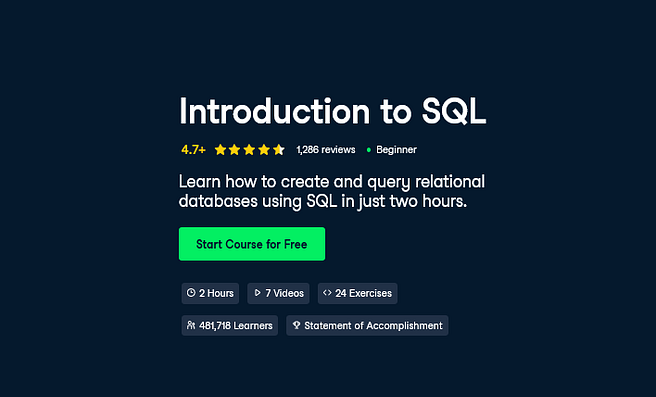
Platform: DataCamp | Duration: 2 hours | Students: 500K+ | Rating: 4.7/5 (1,286 reviews)
This is the quickest path to SQL competency. DataCamp’s interactive, hands-on approach teaches you SQL fundamentals in just 2 hours — more efficiently than any other resource.
What You’ll Learn:
- Relational database organization
- SQL query fundamentals
- SELECT statements and filtering
- Creating queries to extract data
- Organizing and understanding data
- PostgreSQL and SQL Server differences
- Data types and best practices
- Writing practical SQL queries
- Handling query results
Why It’s Essential for 2026: DataCamp specializes in making complex topics accessible. The 2-hour format is perfect if you’re time-constrained. You get solid fundamentals without drowning in 50+ hours of content.
Best For:
- Busy professionals needing quick upskilling
- Data analysts and scientists starting with SQL
- Anyone wanting a fast introduction
- Those preferring interactive over video learning
Interactive Format: Every concept includes executable code. You’re not passively watching — you’re actively coding.
Quick Wins: You’ll write practical SQL queries within the first 30 minutes. You’ll feel productive immediately.
Progression Path: After this course, DataCamp offers Intermediate SQL Queries and SQL for Joining Data for deeper learning.
Time Investment: 2 hours minimum, but plan for 5–10 hours with practice
Certification Value: DataCamp certificates show you’ve completed verified coursework with actual coding proficiency demonstrated.
Here is the link to join this course — -Introduction to SQL on Datacamp
Note: Requires DataCamp Plan (~$25/month annually for Standard plan). Includes 350+ courses across data science, analytics, and engineering. The great thing is that they are offering 50% discount now which is a perfect way to start new year.
7. High-Performance SQL Course by Vlad Mihalcea
Platform: Teachable | Instructor: Vlad Mihalcea | Duration: 18+ hours | Level: Advanced | Focus: Performance Optimization
This is the most advanced SQL course available. Vlad is a legendary database performance expert — if you want to master high-performance SQL, this is your resource.
What You’ll Learn:
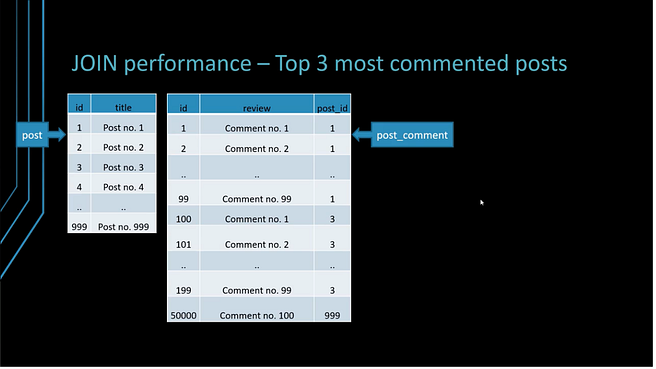
- Advanced JOIN strategies and best practices
- Subqueries, semi-joins, and derived tables
- Common Table Expressions (CTEs) and recursive queries
- Window functions and analytical queries
- JSON processing and manipulation
- PIVOT, UPSERT, and MERGE operations
- Pagination best practices
- Query execution plans and analysis
- Index strategies for performance
- Understanding EXPLAIN and ANALYZE
- Demystifying database query optimization
- Lateral joins and advanced patterns
- Partitioning and sharding strategies
Why It’s Essential for 2026: Most developers can write SQL that works. Vlad teaches SQL that performs. The difference is massive — the gap between a query that takes 10 seconds and one that takes 100 milliseconds. This course teaches you to be in the latter category.
Best For:
- Advanced developers wanting performance expertise
- Database engineers and DBAs
- Anyone optimizing slow queries in production
- Developers targeting senior technical roles
- Those building high-scale systems
Author Credibility: Vlad Mihalcea is a legendary figure in the database community. He’s worked on Hibernate, JPA, and countless enterprise systems. His expertise is unmatched.
Unique Strength: This course doesn’t just teach advanced SQL — it teaches how databases actually work. You learn the internals that let you write queries that align with how the database optimizer thinks.
Real Production Skills: Every concept is tied to real performance problems Vlad has solved in production. You learn patterns that actually matter.
Time Investment: 18+ hours of content, plan for 30–40 hours with practice and experiments
Career Impact: Engineers with deep performance optimization skills are rare. If you master this course, you’re in the top 1% of SQL developers. That’s reflected in both salaries and job opportunities.
Hands-On Experimentation: The course encourages you to actually test and measure query performance. You develop intuition about how databases work.
Database Coverage: Examples work across PostgreSQL, MySQL, SQL Server, and Oracle.
Here is the link to join this course — — High-Performance SQL Course by Vlad Mihalcea
Key Recommendations by Goal
Here are the key recommendations based upon your goals when it comes to learning SQL:
If you want the fastest path: DataCamp — Introduction to SQL (2 hours, hands-on, immediate practice)
If you’re completely new to SQL: Udemy — The Complete SQL Bootcamp (Clear instruction, 1.2M+ students, proven approach)
If you want data science focus: Coursera — SQL for Data Science (UC Davis credential, data-focused content)
If you prefer interactive learning: Educative — An Introductory Guide to SQL (No setup needed, write code immediately)
If you want comprehensive mastery: ZTM Academy — Complete SQL + Databases Bootcamp (25+ hours, everything you need, real-world focus)
If you want foundational understanding: Frontend Masters — Complete Intro to Databases (Learn the why, not just the how)
If you want performance optimization mastery: Vlad Mihalcea — High-Performance SQL Course (Expert-level, real performance techniques, internals focus)
By the way, if you always wanted to join Coursera, they are now offering 50% discount now and you can get it for just $199.

My Personal SQL Course Recommendation for 2026
If I could recommend one learning path for any developer serious about SQL mastery, it would be:
The 8-Week SQL Mastery Path:
Week 1: Frontend Masters: Complete Intro to Databases (5 hours)
- Understand database fundamentals
- Learn the principles that matter
- Build conceptual foundations
Weeks 2–4: Udemy: The Complete SQL Bootcamp (13.5 hours)
- Master SQL syntax and queries
- Learn all major concepts
- Code along with instructor
- Plan 25–30 hours total including practice
Weeks 5–6: Coursera: SQL for Data Science (4 weeks)
- Apply SQL to real data analysis
- Work with actual datasets
- Complete hands-on assignments
- Earn UC Davis certificate
Weeks 7–8: Build 2–3 Real Projects
- Find datasets on Kaggle or GitHub
- Ask real business questions
- Write SQL to answer them
- Document your work
Plus: Daily practice on LeetCode SQL (30 minutes/day)
Total Time Investment: 60–80 hours over 8 weeks
Outcome: Professional SQL expertise, portfolio projects, job-ready skills
ROI: This investment could add $15K-30K to your annual salary if you’re transitioning roles, or increase your value in your current position significantly.
Complement with Practice Platforms
Reading and watching courses are essential, but SQL is best learned by doing. Combine these courses with:
- LeetCode SQL — 200+ practice problems, difficulty progression
- HackerRank SQL — Beginner-friendly, good tutorials
- Kaggle Datasets — Real data for practice projects
- Mode Analytics SQL Tutorial — Free, interactive, excellent
- SQL Puzzle Books — Advanced problem-solving using SQL
Why SQL Matters in 2026?
I probably don’t need to answer this because you already know that how important SQL is in this age of data, machine learning and AI, but just in case, here is why SQL matters in 2026:
Career Opportunities:
- Every data role requires SQL expertise
- Full-stack developers increasingly need SQL
- Database administrators command premium salaries
- Data scientists use SQL daily
Technical Excellence:
- SQL is the universal language for data
- Understanding SQL makes you better at other skills
- Database knowledge is foundational to system design
- Query optimization skills are always in demand
Job Market Reality:
- 95% of data roles require SQL proficiency
- Developers with strong SQL skills earn 20–30% more
- SQL is one of the most stable, long-term skills
Competitive Advantage:
- Many developers know basic SQL but lack depth
- Deep SQL knowledge differentiates you from competition
- Optimization skills are rare and valuable
- Database design knowledge is increasingly rare
The Bottom Line
That’s all about the best SQL courses for 2026. SQL is not optional in 2026 — it’s foundational. Whether you’re a full-stack developer, data scientist, analyst, or backend engineer, SQL is essential.
These 6 courses represent the pinnacle of SQL education:
- Udemy for comprehensive, engaging instruction
- Coursera for credible, data-focused learning
- Educative for interactive, hands-on practice
- Frontend Masters for foundational understanding
- ZTM Academy for comprehensive mastery
- DataCamp for fast-track learning
Pick one course. Complete it. Practice daily. Build projects.
The developers winning in 2026 aren’t magically more talented. They invested time in mastering SQL when others treated it as optional.
Will you be one of them?
P.S. — I’m revisiting these SQL courses because I know database and SQL skills are more valuable in 2026 than ever. Data is the new oil. SQL is the language of data. The engineers who master SQL are the ones solving hard problems, building scalable systems, and earning premium salaries.
Start today. Pick one course like The Complete SQL Bootcamp. Write one query. Solve one problem.
Consistency compounds. In 3–6 months, you’ll be unrecognizable.
Master SQL. Master your career.


 Posts
Posts


No comments :
Post a Comment