Knowledge of Object-oriented design principles and various OOP design patterns is a must for any experienced Java developer. It helps them to create robust code that can withstand test of time in production. As I have said earlier on 10 OOP and SOLID design principles, coding without knowing these principles is like trying to learn a language without knowing the alphabet. If you don't know alphabets, you will struggle with understanding the words and using them. Now the question is how can a Java developer learn these design principles and patterns? Which books and courses one should take to learn and master this essential skill for experienced Java developers? This is what I am going to answer in this post. I will share some of the best books and courses to learn Design patterns for Java and JEE developers.
Friday, September 4, 2026

Wednesday, April 22, 2026
Microservices are Mess without these Patterns
Hello folks, while the industry trend is to split your monolithic application to microservices to segregate data, code, and interface, it's not an easy task to do.
Especially if you don’t have any experience in Microservice development and are not familiar with the best practices and essential Microservices design patterns and principles.
Liked Object Oriented Design Patterns, Microservice Patterns are also tried and tested solutions to common problems people have encountered while developing, deploying, and scaling their Microservices.
For example, the SAGA pattern solves the problem of distributed transaction failures, and the API gateway makes client-side code easier and also acts as a front controller and load balancer for many of your Microservices, thus making them more maintainable.
In the past, I have talked about how SOLID Principles Level Up Your Engineering, and in this article, I am going to give you a brief overview of essential Microservice patterns and when to use them with simple examples and scenarios.
This is the minimum you need to know and remember as a Microservice developer, if you know the basics and have a bit of idea, you can always go back and search and learn them in depth before you use them in your project.
Here are some popular Microservice design patterns that a programmer should know:
Service Registry
Circuit Breaker
API Gateway
Event-Driven Architecture
Database per Service
Command Query Responsibility Segregation (CQRS)
Externalized Configuration
Saga Pattern
Bulkhead Pattern
Backends for Frontends (BFF)
By the way, if you are new to Microservice architecture or just want to revise key Microservice concepts and looking for resources then here are a few online courses you can join:
10 Battle-Tested Microservices Patterns from Real-World Applications
Here is a list of popular Microservices design patterns that every developer should know and learn if they are working in Microservices or breaking their monolithic application into Microservices to separate code, data, and interfaces:

1. Service Registry Pattern in Microservices
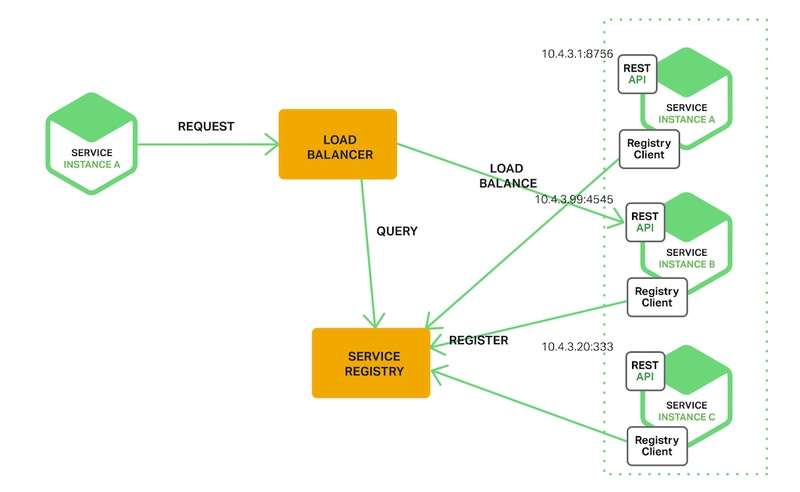
The Service Registry Pattern provides a central repository to discover Microservices by name.
It is a microservice architecture pattern that enables services to discover other Microservices and communicate with each other.
In this pattern, a central service registry or directory is used to keep a record of the available services and their locations.
Microservices can register themselves with the registry, and other Microservices can look up the registry to find the location of the required services.
For example, suppose we have a large e-commerce website that consists of many microservices, such as an order service, a payment service, a shipping service, and a customer service.
Each of these services has its own REST API that other services can use to communicate with it.
To make it easier for these services to discover each other, we can use the Service Registry Pattern.
We can set up a service registry, such as Consul or Eureka (Spring Cloud provides this), that maintains a list of all the available services and their endpoints.
When a service starts up, it can register itself with the registry by providing its name and endpoint.
For example, the order service might register itself as “order-service” with an endpoint of “http://order-service:8080".
Other services that need to communicate with the order service can then look up its endpoint in the registry using its name.
For instance, the payment service might look up the “order-service” endpoint in the registry to send payment information to the order service.
Similarly, the shipping service might look up the “order-service” endpoint in the registry to get shipping information for an order.
This way, each service can be developed and deployed independently, without hard-coding the endpoints of other services in its code.
The Service Registry Pattern enables the services to locate each other dynamically, making the system more flexible and resilient to changes.
2. Circuit Breaker Pattern
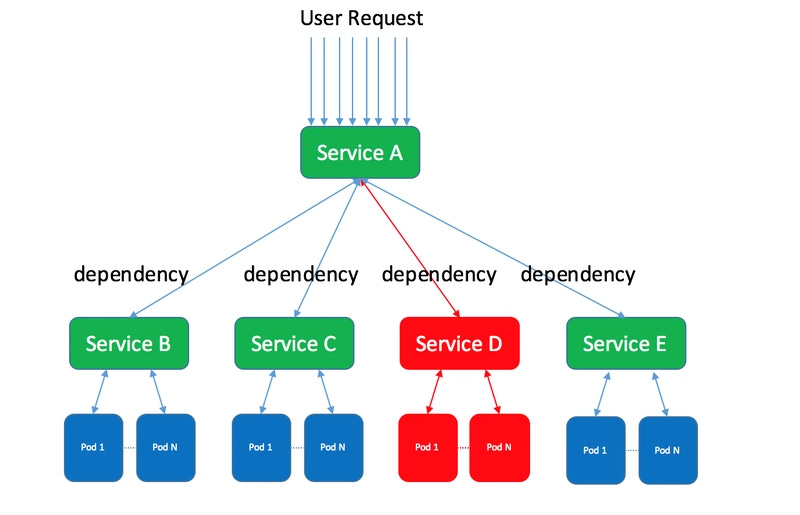
As the name suggests, the Circuit Breaker pattern prevents cascading failure by breaking the circuit and enables applications to continue functioning when one or more services fail.
It is used to handle faults that may occur in a microservice architecture.
In this pattern, a circuit breaker acts as a safety net between the client and the service, protecting the client from failures in the service.
The circuit breaker monitors the status of the service and, if it detects that the service is failing, it can open the circuit and prevent further requests from being sent to the service until the service has recovered.
For example, suppose a Microservice application is using an external service that is unreliable, and the application needs to continue functioning even if the external service fails.
In this scenario, the Circuit Breaker pattern can be used to detect when the external service is unavailable and switch to an alternative service or a fallback service until the external service becomes available again.

In a Microservice architecture, the Circuit Breaker pattern can be implemented using tools such as Netflix’s Hystrix or Spring Cloud Circuit Breaker, which provide a way to manage the circuit breaker’s behavior and allow the application to react to service failures in a controlled manner.
3. API Gateway Pattern
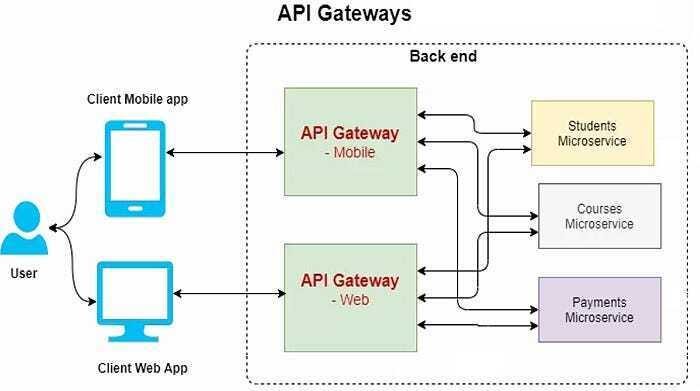
The API Gateway Pattern is another common design pattern used in microservices architecture that involves an API gateway, which acts as an entry point for all incoming API requests.
It provides a single point of entry for all the microservices and acts as a proxy between the clients and the microservices, routing requests to the appropriate service.
The main purpose of an API gateway is to decouple the clients from the microservices, abstracting the complexity of the system behind a simplified and consistent API.
This also means that you don’t need to find and remember the addresses of 100+ Microservice REST APIs.
It also provides an additional layer of security and governance, allowing organizations to control and manage access to their services, monitor the performance of the system, and enforce policies across all the services.
Here is an example of how the API Gateway pattern works in a simple e-commerce system:
Suppose an e-commerce system has multiple microservices to handle different functions such as order management, product catalog, and user authentication.
Each microservice has its API endpoint for handling requests. However, the client, which could be a web or mobile application, needs to access all these microservices through a single entry point.
This is where an API Gateway comes into play. The API Gateway acts as a reverse proxy that receives all incoming requests from the clients.
It then routes each request to the appropriate microservice based on the endpoint requested.
For example, an API Gateway might route requests to /orders endpoint to the order management microservice, and requests to /products endpoint to the product catalog microservice.
The API Gateway can also perform additional functions such as request and response transformation, rate limiting, authentication and authorization, and caching.
It can also provide a unified API that hides the internal details of the Microservices and presents a simpler and consistent interface to the clients.
Overall, the API Gateway pattern provides a scalable, flexible, and secure way to manage microservices in a complex system, making it easier to develop, deploy, and maintain Microservices-based applications.
4. Saga Pattern
The Saga pattern provides a way to manage transactions that involve multiple microservices.
It is used to ensure that a series of transactions across multiple services are completed successfully, and if not, to roll back or undo all changes that have been made up to that point.
The Saga pattern consists of a sequence of local transactions, each of which updates the state of a single service, and a corresponding set of compensating transactions that are used to undo the effects of the original transactions in case of a failure.
Here’s an example of how the Saga pattern is used in A microservice-based e-commerce application:
Suppose you have two microservices, one responsible for processing orders and another responsible for shipping orders.
When a new order is placed, the order processing service is responsible for validating the order and ensuring that the items are in stock, while the shipping service is responsible for packaging the order and sending it to the customer.
If the order processing service determines that the order is valid and all items are in stock, it sends a message to the shipping service to initiate the shipping process.
At this point, the Saga pattern comes into play.
The shipping service will create a new transaction to package and ship the order, and if the transaction is successful, it will mark the order as shipped.
If, on the other hand, the transaction fails (perhaps due to a problem with the shipping provider), the shipping service will initiate a compensating transaction to undo the effects of the original transaction, such as canceling the shipment and restocking the items.
Meanwhile, the order processing service is also using the Saga pattern to manage its own transactions.
If the shipping service reports that the order has been shipped successfully, the order processing service will mark the order as completed.
If the shipping service reports a failure, the order processing service will initiate a compensating transaction to cancel the order and return any funds that were paid.
Overall, the Saga pattern provides a way to manage complex transactions across multiple microservices in a way that ensures consistency and reliability.
If you have to just learn one pattern, you better learn SAGA patterns as its immensely helpful in Microservice applications.
5. Event Sourcing Pattern
Event Sourcing is a Microservice pattern used for persisting and querying data in an application.
Instead of storing the current state of an object, Event Sourcing persists in all events that occur in the application, allowing the state of the object to be reconstructed at any point in time.
In this pattern, every state change in the application is captured as an event and stored as a log of events.
The state of the application can be reconstructed by replaying these events. This means that Event Sourcing provides an audit log of all changes that occur in the application.
For example, consider an e-commerce application. When a user places an order, an OrderPlaced event is generated and stored in the log.
When the order is shipped, an ShipmentMade event is generated and stored in the log.
If the order is canceled, an OrderCanceled event is generated and stored in the log. By replaying the events, the current state of the order can be determined.

Event Sourcing has several benefits:
Auditability: All changes to the system can be audited and traced back to their source.
Scalability: Events can be processed in parallel, allowing for better scalability.
Flexibility: Because the events are the source of truth, it’s possible to change the way the data is queried and persisted without changing the data itself.
Fault-tolerance: Because the events are immutable, they cannot be modified, ensuring that the data is always correct.
However, implementing Event Sourcing can be complex and requires careful planning.
Additionally, querying the data can be slower because it involves replaying all events so you make sure that you need it before using it.
More often than not, there will be an alternative solution.
6. Command Query Responsibility Segregation (CQRS) Pattern:
Command Query Responsibility Segregation (CQRS) pattern is another popular Microservice design pattern that separates commands (write operations) and queries (read operations) into separate models, each with its own database.
The pattern is based on the idea that the models used for writing data are not the same as the models used for reading data.
In this pattern, a Command Model receives commands from the client and writes them to the database.
The Query Model reads from the database and sends data to the client.
The pattern can be used to improve the performance and scalability of a system, as each model can be optimized for its specific task.
For example, consider an e-commerce application that uses a traditional CRUD-based approach to managing product information.
The same model and database are used to handle both reading and writing product information.
As the application grows, the model becomes increasingly complex, and the database becomes a performance bottleneck.
Using CQRS, the application would have a separate Command Model for writing product information and a separate Query Model for reading product information.
The Command Model would be optimized for fast writes, while the Query Model would be optimized for fast reads.
The Command Model would store data in a write-optimized database, while the Query Model would store data in a read-optimized database. The two models would communicate through an event bus or message queue.
Overall, CQRS can improve the scalability and performance of a system, as well as simplify the code base by separating concerns.
However, it can also add complexity and require more development effort, as separate models and databases are required.
7. Bulkhead Pattern
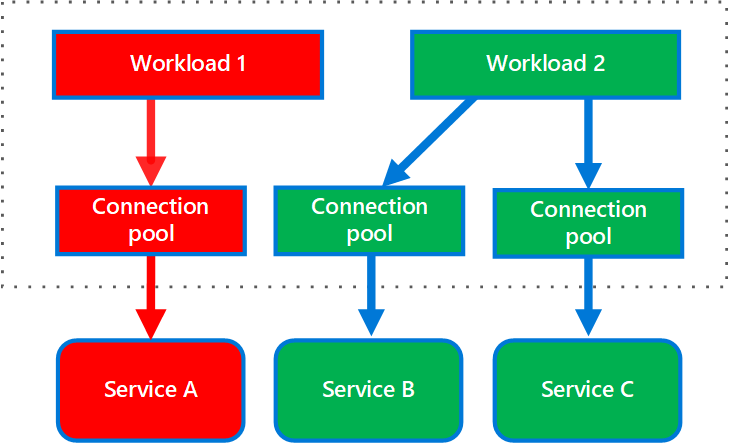
The bulkhead design pattern is a way of isolating different parts of a system so that a failure in one part does not affect the rest of the system.
In a Microservice architecture, the bulkhead pattern can be used to isolate different microservices so that a failure in one microservice does not bring down the entire system.
This looks quite similar to the circuit breaker pattern, which also prevents cascade failure, but instead of breaking the circuit, this design pattern focuses on isolation and self-sufficient Microservices as shown in the diagram below. Service A has its connection pool, which is not shared between Service B and Service C.
The Grokking Microservices Design Patterns course on DesignGuru also has a good example of this microservice pattern for further learning.

8. Backends for Frontends (BFF)
Backends for Frontends (BFF) is a design pattern used in microservice architecture to handle the complexity of client-server communication in the context of multiple user interfaces.
It suggests having a separate back-end service for each front end to handle the specific needs of that interface.
This allows developers to optimize the data flow, caching, and authentication mechanisms for the unique needs of the front-end while keeping the back-end services modular and decoupled.
For example, suppose you have a web application and a mobile application that need to access the same set of services.
In this case, you can create separate back-end services for each application, each optimized for the specific platform.
The web application back-end can handle large amounts of data for faster loading, while the mobile application back-end can optimize for lower latency and network usage.
You can further check the Grokking Microservices Design Patterns course on DesignGuru to learn more about Microservices design patterns.
This pattern enables teams to optimize the user experience for each interface by using separate back-end services for each of them.
It also allows them to avoid having a single back-end service that needs to serve many different interfaces with different needs, which can become increasingly complex and hard to maintain.
Summary
Wow, that’s a long write and read, but now that we have learned basic stuff about essential Microservice design patterns, now is the time to summarize it in one word so that you will remember them easily and decide when to use them
Here are some popular Microservice design patterns that a programmer should know:
The Service Registry pattern provides a central location for services to register themselves.
Circuit Breaker allows your services to fail fast and prevent cascading failures, the circuit breaker pattern is used to isolate a failing service.
API Gateway provides a common entry point for all the requests and responses from the system. So, the client only remembers one host/port address rather than multiple IPs for each Microservice.
Event-driven architecture allows services to communicate with each other by emitting events.
In Database per Service, each service has its own database, which allows services to operate independently.
Command Query Responsibility Segregation (CQRS) separates read and write requests for an application, allowing better scaling and performance.
Externalized Configuration allows storing configuration data outside of the application code, making it easier to manage configuration changes.
Saga Pattern manages the transaction for long-running transactions that span multiple services.
Bulkhead Pattern isolates failures within a microservice, so a single failure does not bring down the entire system.
The Backend for Frontends (BFF) design pattern provides a specific backend for each client. It allows the front-end team to develop features and add new client-specific functionality quickly.
And, if you want to learn more, there is a nice book called Microservices Patterns by Chris Richardson, which is definitely worth reading for Java developers.

That’s all about 10 essential Microservices design patterns which I think every programmer should know and learn.
Each pattern has its advantages and disadvantages, and the choice of pattern will depend on the specific needs of the application, but unless you know what they do and what problem they solve, you cannot use them in the real world. That’s where this article helps.
By the way, these are just a few of the many microservice design patterns that are available, which you can learn on your own. I will also be sharing more patterns in the future.
By the way, if you are new to Microservice architecture or just want to revise key Microservice concepts and looking for resources then here are a few online courses you can join:
- Grokking Microservices Design Patterns [DesignGuru.io]
- Master Microservices with Spring Boot and Spring Cloud [Udemy]
- Building Scalable Java Microservices with Spring Boot [Coursera]
- Developing Microservices with Spring Boot [Educative]
- Master Microservices with Java, Spring, Docker, Kubernetes [Udemy]
Sunday, March 15, 2026
Stop Memorizing Microservices — Master These 20+ Patterns for Any System Design Interview

image_credit - ByteByteGo
Hello friends, if you are preparing for system design interviews, then it make sense to to prepare for Microservices design patterns as well, not just to do well on interviews or make your architecture more robust, but also to understand existing projects.
Microservices patterns like Circuit Breaker, API Gateway, Saga, and Event Sourcing are tried and tested solutions to common Microservices Problems.
These patterns address common challenges in microservices architectures like scalability, fault tolerance, and data consistency.
In the past, I have talked about common system design questions like API Gateway vs Load Balancer and Horizontal vs Vertical Scaling, Forward proxy vs reverse proxy, as well as common System Design problems, and in this article, I am going to share 24 key Microservices design patterns that are essential knowledge for technical interviews.
They are also one of the essential System design topics for an interview, and you must prepare them well.
Many companies use microservices, so understanding these patterns shows you’re up-to-date with current trends. Knowing when and how to apply these patterns also demonstrates your ability to solve complex distributed system problems.
These patterns often involve trade-offs, allowing you to showcase your analytical thinking and Interviewers often present scenarios where these patterns are relevant solutions.
By the way, if you are preparing for System design interviews and want to learn System Design in depth, then you can also checkout sites like ByteByteGo, Design Guru, Exponent, Educative, Codemia.io, and Udemy, which have many great System design courses and a System design interview template like this,s which you can use to answer any System Design question.

If you need more choices, you can also see this list of the best System Design courses, books, and websites
P.S. Keep reading until the end. I have a free bonus for you.
So, what are we waiting for? Let’s jump right into it
19 Microservices Design Patterns for System Design Interviews
Microservices architecture is a design approach that structures an application as a collection of loosely coupled services.
To build scalable, maintainable, and resilient microservices-based systems, various patterns have emerged.
Here are essential microservices patterns you can use in your project, and also remember for system design interviews.
1. Service Registry
Since there are many microservices in a Microservice architecture, they need to discover and communicate with each other.
A Service Registry, such as Netflix Eureka or Consul, acts as a centralized directory where services can register themselves and discover others.
Here is what it looks like:
2. API Gateway
An API Gateway serves as a single entry point for client applications, aggregating multiple microservices into a unified API.
It handles requests, routing them to the appropriate services, and may perform tasks like authentication, authorization, and load balancing.
Here is what API Gateway looks like:
3. Circuit Breaker
Inspired by electrical circuit breakers, this pattern prevents a microservice failure from cascading to other services. Circuit breaker pattern monitors for failures, and if a threshold is crossed, it opens the circuit, preventing further requests.
This helps in graceful degradation and fault tolerance, and it’s absolutely must in a Microservice architecture to prevent total shutdown of your services.
Here is an example of Netflix Hysrix as a Circuit breaker:
4. Bulkhead
In a microservices system, isolating failures is crucial. The Bulkhead pattern involves separating components or services to contain failures.
For example, thread pools or separate databases for different services can be used to prevent a failure in one part of the system from affecting others.
Here is a diagram showing the Bulkhead pattern in Microservices architecture:
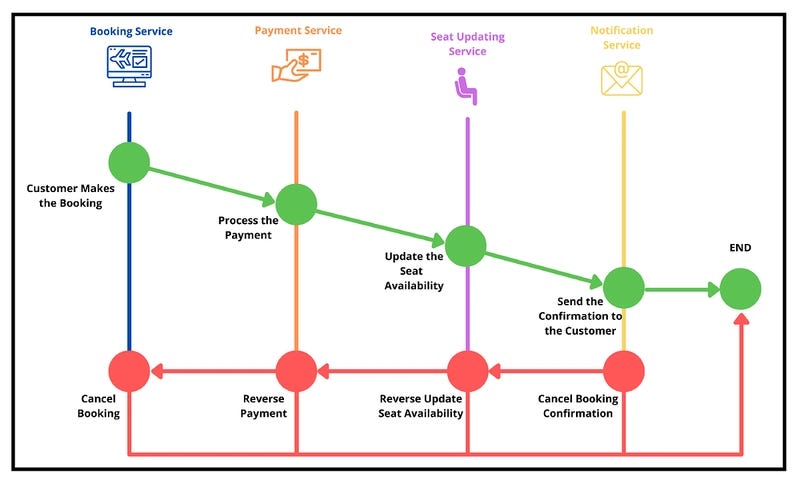
5. Saga Pattern
This pattern is used for managing distributed transactions. The Saga pattern breaks down a long-running business transaction into a series of smaller, independent transactions.
Each microservice involved in the saga handles its own transaction and publishes events to trigger subsequent actions.
Here is how the Saga Pattern looks in action:
6. Event Sourcing
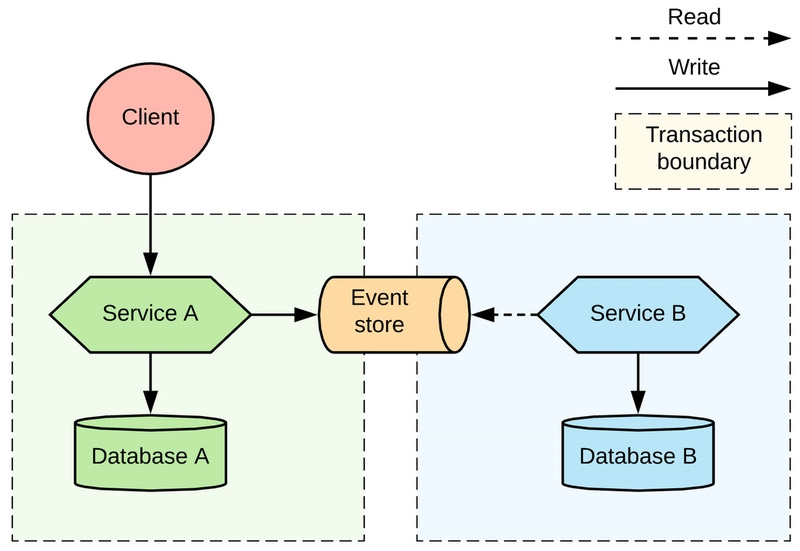
This is another popular pattern that is used heavily in high-frequency low-latency applications.
In this pattern, instead of storing only the current state, Event Sourcing involves storing a sequence of events that led to the current state.
This pattern provides a reliable audit trail and allows for rebuilding the system state at any point in time.
Here is how Event Sourcing looks in action:
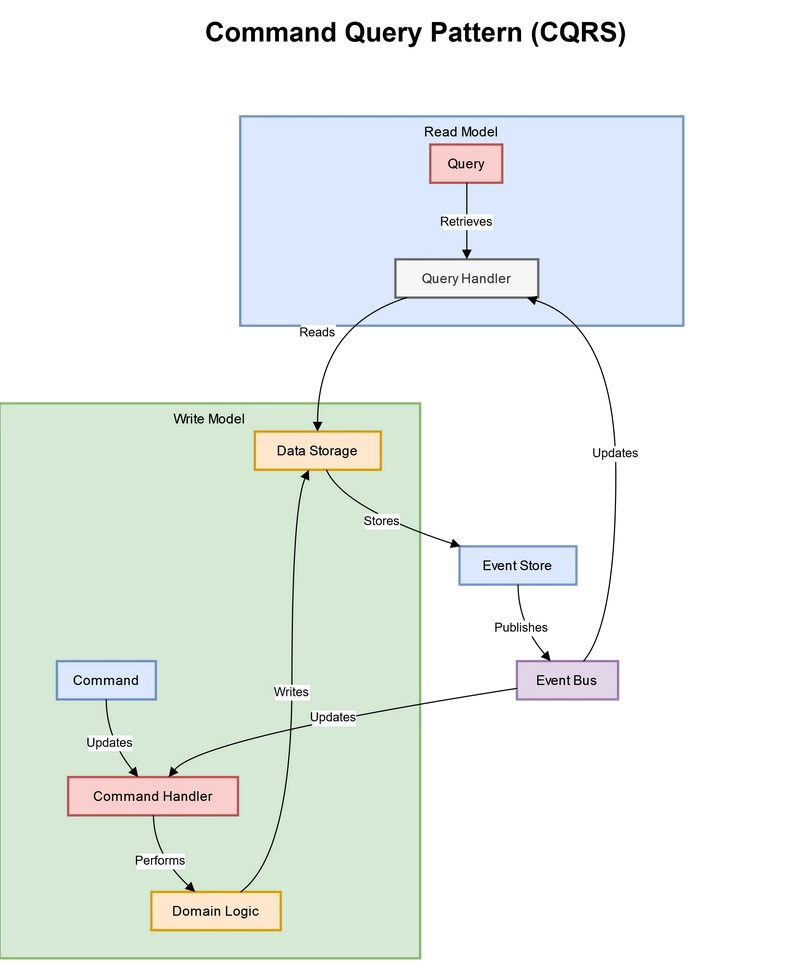
7. Command Query Responsibility Segregation (CQRS)
The CQRS Pattern separates the read and write sides of an application. It uses different models for updating information (commands) and reading information (queries).
This pattern can improve scalability, as read and write operations have different optimization requirements.
Here is a nice diagram that shows the CQRS pattern:
8. Data Sharding
The database sharding pattern is used to distribute the database load and avoid bottlenecks. Data Sharding involves partitioning data across multiple databases or database instances.
In this pattern, each microservice may handle a subset of data or specific types of requests.
Here is how database sharding looks, credit - Design Guru

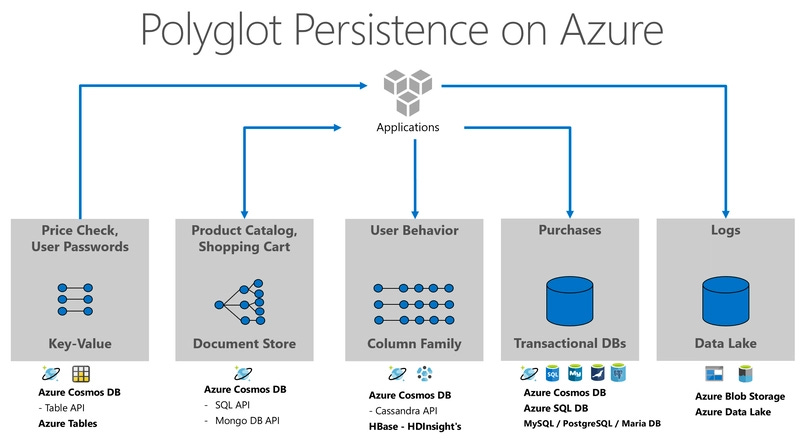
9. Polyglot Persistence
Different microservices may have different data storage needs. Polyglot Persistence allows using multiple database technologies based on the requirements of each microservice, optimizing for data storage, retrieval, and query capabilities.
Here is a nice diagram that shows Polyglot persistence in Azure :
10. Retry
In Microservice architecture, when a transient failure occurs, the Retry pattern involves retrying the operation instead of immediately failing.
It can be applied at various levels, such as service-to-service communication or database interactions.
Here is a nice diagram from ByteByteGo, a great place for system design learning, which shows the Retry pattern in Microservices:

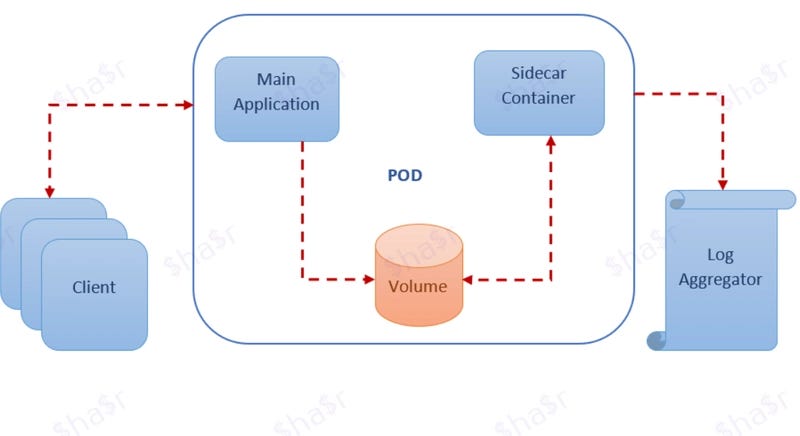
12. Sidecar
The Sidecar pattern involves attaching a helper service (the sidecar) to the main microservice to provide additional functionalities such as logging, security, or communication with external services.
This allows the main service to focus on its core functionality.
Here is what a Sidecar pattern looks like:
13. Backends for Frontends (BFF)
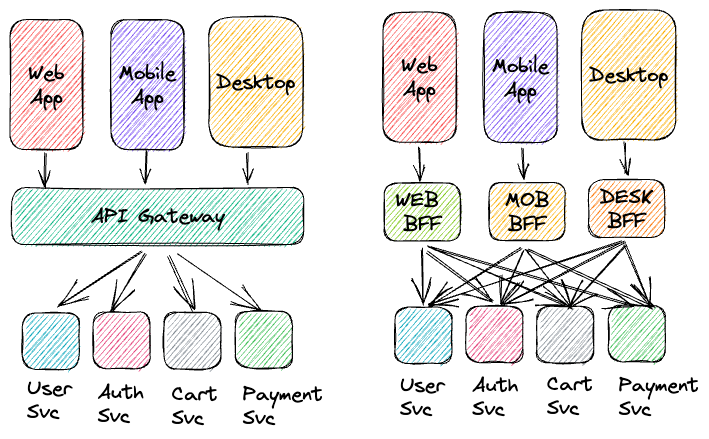
Also known as BFF, this pattern is useful when dealing with multiple client types (e.g., web, mobile). The BFF pattern involves creating separate backend services tailored for each type of client.
This allows for optimized and specialized APIs for each client.
Here is what a Backends for Frontends (BFF) pattern looks like:
14. Shadow Deployment
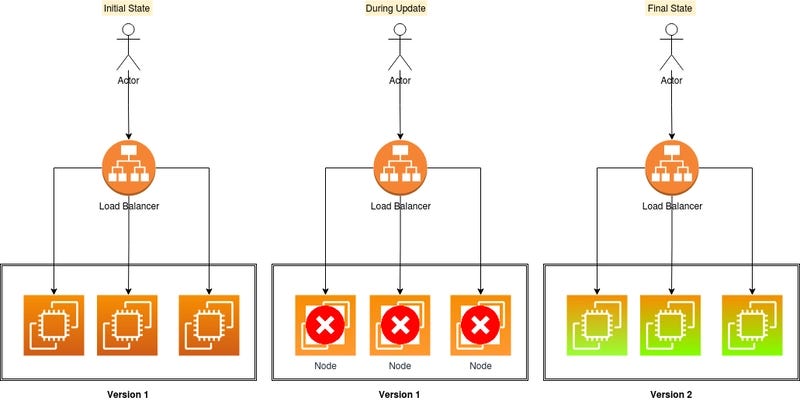
The Shadow Deployment pattern involves routing a copy (shadow) of production traffic to a new microservice version without affecting the actual user experience.
This is one of the popular deployment strategies, and it helps validate the new version’s performance and correctness.
Here is what shadow deployment looks like
15. Consumer-Driven Contracts
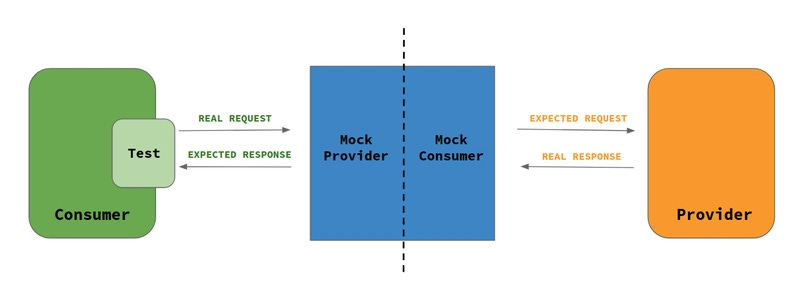
In a microservices ecosystem, multiple services often interact with one another. The Consumer-Driven Contracts pattern involves consumers specifying their expectations from producers, allowing for more robust and coordinated changes.
Here is a nice diagram that explains Consumer-Driven contracts
16. Smart Endpoints, Dumb Pipes
This pattern advocates for placing business logic in microservices (smart endpoints) rather than relying on complex middleware. The communication infrastructure (pipes) should be simple and handle only message routing.
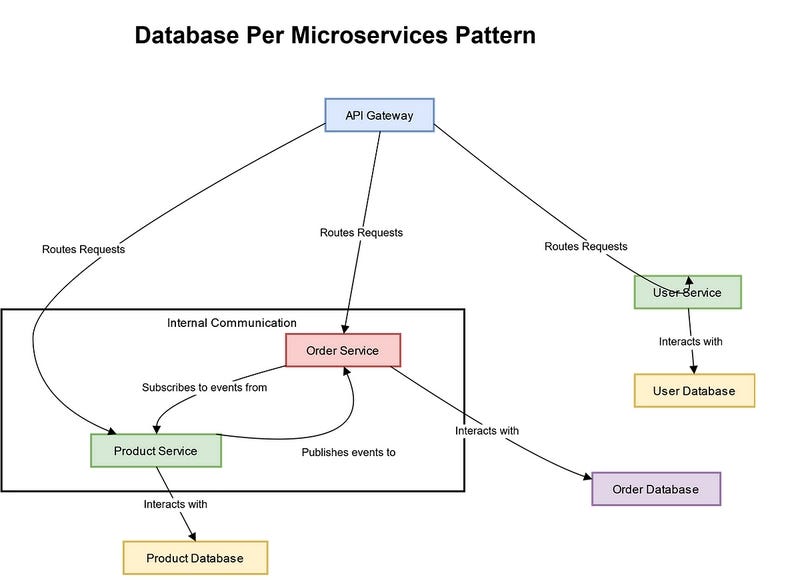
17. Database per Service
This is another popular Microservices pattern where each microservice has its own database, and services communicate through well-defined APIs.
Database per Service pattern provides isolation but also requires careful consideration of data consistency and integrity.
Here is how this pattern looks:
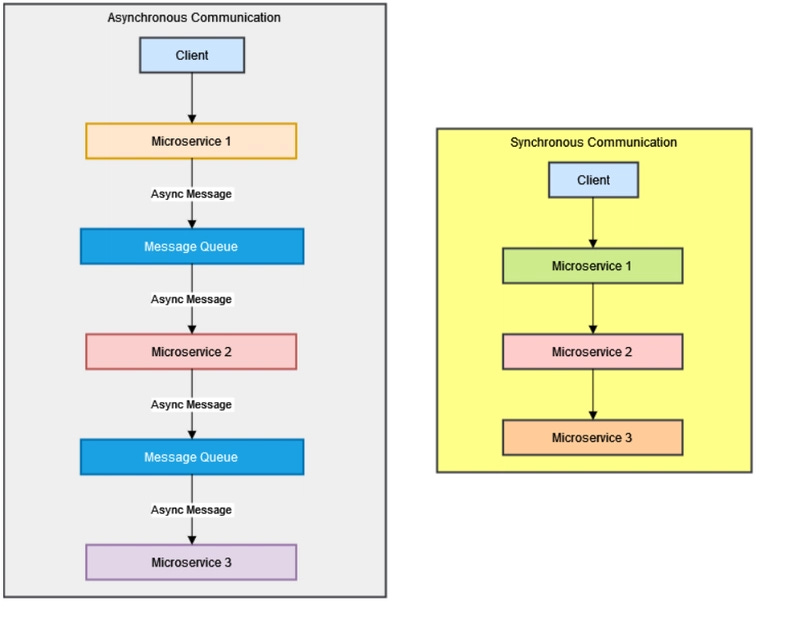
18. Async Messaging
Instead of synchronous communication between microservices, the Async Messaging pattern involves using message queues to facilitate asynchronous communication. This can improve system responsiveness and scalability.
Here is a nice diagram that shows the difference between sync and async messaging
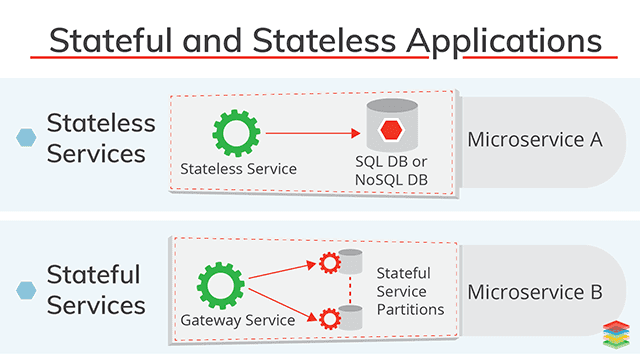
19. Stateless Services
Designing microservices to be stateless simplifies scalability and resilience. Each service processes a request independently, without relying on stored state, making it easier to scale horizontally.
Here is a nice diagram that shows the difference between Stateless Services and Stateful Services
System Design Interviews Resources
And, here is my curated list of best system design books, online courses, and practice websites which you can check to better prepare for System design interviews. Most of these courses also answer questions I have shared here.
DesignGuru’s Grokking System Design Course: An interactive learning platform with hands-on exercises and real-world scenarios to strengthen your system design skills.
Codemia.io : This is one of the best places to practice System design problems for interviews online. It got more than 120+ System design problems, many of them are free,e and also a proper structure to solve them.
Exponent: A specialized site for interview prep, especially for FAANG companies like Amazon and Google. They also have a great system design course and many other material which can help you crack FAANG interviews.
“Designing Data-Intensive Applications” by Martin Kleppmann: A comprehensive guide that covers the principles and practices for designing scalable and reliable systems.
LeetCode System Design Tag: LeetCode is a popular platform for technical interview preparation. The System Design tag on LeetCode includes a variety of questions to practice.
“System Design Primer” on GitHub: A curated list of resources, including articles, books, and videos, to help you prepare for system design interviews.
Educative’s System Design Course: An interactive learning platform with hands-on exercises and real-world scenarios to strengthen your system design skills.
High Scalability Blog: A blog that features articles and case studies on the architecture of high-traffic websites and scalable systems.
YouTube Channels: Check out channels like “Gaurav Sen” and “Tech Dummies” for insightful videos on system design concepts and interview preparation.
ByteByteGo: A live book and course by Alex Xu for System design interview preparation. It contains all the content of the System Design Interview book volumes 1 and 2, and will be updated with volume 3, which is coming soon.
“System Design Interview” by Alex Xu: This book provides an in-depth exploration of system design concepts, strategies, and interview preparation tips.

image_credit - ByteByteGo
That’s all about the common Microservice patterns and concepts a developer should know. These microservices patterns help address various challenges associated with building and maintaining distributed systems, providing solutions for communication, fault tolerance, data management, and scalability.
When designing microservices architectures, combining these patterns judiciously can lead to a robust and resilient system.
These additional microservices patterns, when applied thoughtfully, contribute to building resilient, scalable, and maintainable distributed systems.
The choice of patterns depends on the specific requirements and challenges faced during the design and implementation of microservices architectures.
Subscribe to:
Posts
(
Atom
)


 Posts
Posts

